

Who Did Lady Macbeth Kill
| Lady Macbeth | |
|---|---|
| Macbeth character | |
 Lady Macbeth observes Male monarch Duncan (Lady Macbeth by George Cattermole, 19th century) | |
| Created past | William Shakespeare |
| Portrayed by | Sarah Siddons Charlotte Melmoth Charlotte Cushman Helen Faucit Ellen Terry Jeanette Nolan Vivien Leigh Judith Anderson Simone Signoret Vivien Merchant Francesca Annis Judi Dench Maggie Smith Glenda Jackson Angela Bassett Alex Kingston Kate Fleetwood Marion Cotillard Hannah Taylor-Gordon Frances McDormand Saoirse Ronan Florence Pugh |
| In-universe information | |
| Spouse | Macbeth |
Lady Macbeth is a leading grapheme in William Shakespeare'southward tragedy Macbeth (c. 1603–1607). As the married woman of the play's tragic hero, Macbeth (a Scottish nobleman), Lady Macbeth goads her husband into committing regicide, after which she becomes queen of Scotland. After Macbeth becomes a murderous tyrant, she is driven to madness by guilt over their crimes, and commits suicide offstage.
Lady Macbeth is a powerful presence in the play, most notably in the first two acts. Following the murder of Rex Duncan, notwithstanding, her part in the plot diminishes. She becomes an uninvolved spectator to Macbeth'southward plotting and a nervous hostess at a banquet dominated by her hubby'south hallucinations. Her sleepwalking scene in the 5th act is a turning point in the play, and her line "Out, damned spot!" has become a phrase familiar to many speakers of the English language language. The report of her decease belatedly in the 5th deed provides the inspiration for Macbeth's "Tomorrow and tomorrow and tomorrow" oral communication.
The role has attracted countless notable actors over the centuries, including Sarah Siddons, Charlotte Melmoth, Helen Faucit, Ellen Terry, Jeanette Nolan, Vivien Leigh, Simone Signoret, Vivien Merchant, Glenda Jackson, Francesca Annis, Judith Anderson, Judi Dench, Renee O'Connor, Helen McCrory, Keeley Hawes, Alex Kingston, Marion Cotillard, Hannah Taylor-Gordon, and Frances McDormand.
Origins [edit]
Shakespeare's Lady Macbeth appeared to be a composite of two personages found in the business relationship of King Duff and in the account of Rex Duncan in Holinshed's Chronicles: Donwald'south nagging, murderous married woman in the account of Male monarch Duff and Macbeth'due south ambitious wife, Gruoch of Scotland, in the account of King Duncan. In the account of Male monarch Duff, one of his captains, Donwald, suffers the deaths of his kinsmen at the orders of the king. Donwald and then considers regicide at "the setting on of his wife", who "showed him the ways whereby he might soonest achieve it." Donwald abhors such an act, merely perseveres at the nagging of his wife. After plying the king'south servants with nutrient and drink and letting them fall asleep, the couple admit their confederates to the rex'south room, where they then commit the regicide. The murder of Duff has its motivation in revenge rather than ambition.
In Holinshed's account of King Duncan, the discussion of Lady Macbeth is confined to a single sentence:
The words of the three Weird Sisters also (of whom before ye have heard) greatly encouraged him hereunto; but specially his wife lay sore upon him to endeavour the affair, as she was very ambitious, burning with an unquenchable desire to bear the name of a queen.[1]
Office in the play [edit]

Lady Macbeth makes her get-go appearance tardily in scene five of the offset act, when she learns in a letter from her husband that iii witches have prophesied his future as king. Aware her husband's is "too full o' the milk of human kindness" for committing a murder, so, countering her husband's arguments and reminding him that he first broached the matter, finally winning him to her designs.
The king retires later on a nighttime of eating. Lady Macbeth drugs his attendants and lies the daggers ready for the commission of the criminal offence. Macbeth kills the sleeping king while Lady Macbeth waits nearby. When he brings the daggers from the king's room, Lady Macbeth orders him to return them to the scene of the crime. He refuses. She carries the daggers to the room and smears the drugged attendants faces with the kings claret. The couple retire to launder their hands.
Following the murder of Male monarch Duncan, Lady Macbeth's function in the plots diminish. When Duncan's sons flee the land in fearfulness for their ain lives, Macbeth is given rex. Without consulting her, Macbeth plots other murders in order to secure his throne, and, at a royal banquet, the queen is forced to dismiss her guests when Macbeth hallucinates.
When Macbeth orders the death of Macduff, his assassins succeed only in killing his married woman and children. Lady Macbeth is horrified and wracked with guilt, which drives her to kill herself; in her last appearance, she sleepwalks in profound torment, and hallucinates that her hands are stained with the blood of Duncan and Macduff's family unit, scrubbing furiously in a vain endeavor to "make clean" them. She dies off-phase, with suicide being suggested equally its cause when Malcolm declares that she died by "self and violent easily."[2]
In the First Folio, the but source for the play, she is never referred to as Lady Macbeth, but variously as "Macbeth's wife", "Macbeth'south lady", or only "lady"..
Sleepwalking scene [edit]
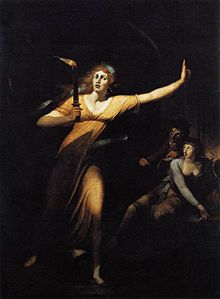
The sleepwalking scene[three] is one of the more celebrated scenes from Macbeth, and, indeed, in all of Shakespeare. It has no counterpart in Holinshed'due south Chronicles, Shakespeare'south source material for the play, simply is solely his invention.[four]
A.C. Bradley notes that, with the exception of its few endmost lines, the scene is entirely in prose with Lady Macbeth being the but major character in Shakespearean tragedy to make a terminal appearance "denied the dignity of poetry." Co-ordinate to Bradley, Shakespeare mostly assigned prose to characters exhibiting abnormal states of mind or abnormal conditions such as somnambulism, with the regular rhythm of verse being inappropriate to characters having lost their balance of mind or subject to images or impressions with no rational connection. Lady Macbeth's recollections – the blood on her hand, the striking of the clock, her husband'south reluctance – are brought forth from her disordered mind in adventure order with each epitome deepening her ache. For Bradley, Lady Macbeth's "brief toneless sentences seem the only voice of truth" with the spare and simple construction of the character'south diction expressing a "desolating misery."[5]
Analyses of the role [edit]
Lady Macbeth as anti-mother [edit]
Stephanie Chamberlain in her article "Fantasizing Infanticide: Lady Macbeth and the Murdering Female parent in Early Modern England" argues that though Lady Macbeth wants power, her power is "conditioned on maternity", which was a "conflicted status in early on modern England". Chamberlain argues that the negative images of Lady Macbeth every bit a mother figure, such as when she discusses her ability to "dash the brains" of the babe that sucks her breast, reflect controversies concerning the image of motherhood in early modern England. In early modern England, mothers were often accused of hurting the people that were placed in their hands. Lady Macbeth then personifies all mothers of early modern England who were condemned for Lady Macbeth's fantasy of infanticide. Lady Macbeth'southward fantasy, Chamberlain argues, is not struggling to exist a homo, but rather struggling with the condemnation of being a bad mother that was mutual during that fourth dimension.[6]

A print of Lady Macbeth from Mrs. Anna Jameson's 1832 analysis of Shakespeare'due south heroines, Characteristics of Women
Jenijoy La Belle takes a slightly different view in her article, "A Strange Infirmity: Lady Macbeth'due south Amenorrhea". La Belle states that Lady Macbeth does not wish for merely a move abroad from femininity; she is request the spirits to eliminate the basic biological characteristics of womanhood. The main biological feature that La Belle focuses on is menstruation. La Belle argues that by asking to be "unsex[ed]" and crying out to spirits to "brand thick [her] claret / Terminate upwards th' access and passage to remorse", Lady Macbeth asks for her menstrual cycle to stop. By having her menstrual cycle cease, Lady Macbeth hopes to stop any feelings of sensitivity and caring that is associated with females. She hopes to become like a man to end any sense of remorse for the regicide. La Belle furthers her argument past connecting the stopping of the menstrual cycle with the persistent infanticide motifs in the play. La Belle gives examples of "the strangled babe" whose finger is thrown into the witches' cauldron (4.1.30); Macduff'south babes who are "savagely slaughter'd" (iv.3.235); and the suckling infant with boneless gums whose brains Lady Macbeth would dash out (1.vii.57–58) to argue that Lady Macbeth represents the ultimate anti-mother: non only would she boom in a infant'south brains just she would go fifty-fifty further to stop her means of procreation altogether.[7]
Lady Macbeth every bit a witch [edit]
Some literary critics and historians contend that not only does Lady Macbeth represent an anti-female parent figure in full general, she likewise embodies a specific type of anti-mother: the witch.[8] Modern day critic Joanna Levin defines a witch every bit a woman who succumbs to Satanic forcefulness, a animalism for the devil, and who, either for this reason or the desire to obtain supernatural powers, invokes (evil) spirits. Levin refers to Marianne Hester'due south Lewd Women and Wicked Witches: A Written report of Male Domination, in which Hester articulates a feminist interpretation of the witch as an empowered adult female. Levin summarises the claim of feminist historians like Hester: the witch should be a figure historic for her nonconformity, disobedience, and general sense of empowerment; witches challenged patriarchal authorization and hierarchy, specifically "threatening hegemonic sex/gender systems". This view associates witchcraft – and past extension, Lady Macbeth – not with villainy and evil, but with heroism.[9]
Literary scholar Jenijoy La Belle assesses Lady Macbeth's femininity and sexuality as they relate to motherhood likewise as witchhood. The fact that she conjures spirits likens her to a witch, and the human activity itself establishes a similarity in the way that both Lady Macbeth and the Weird Sisters from the play "use the metaphoric powers of language to call upon spiritual powers who in turn will influence physical events – in one case the workings of the country, in the other the workings of a woman's body." Like the witches, Lady Macbeth strives to make herself an instrument for bringing about the future.[7]
She proves herself a defiant, empowered nonconformist, and an explicit threat to a patriarchal system of governance in that, through challenging his masculinity, she manipulates Macbeth into murdering Rex Duncan.[10] Despite the fact that she calls him a coward, Macbeth remains reluctant, until she asks: "What animal was't, then, that made you lot break this enterprise to me? / When you durst practise it, and then y'all were a human being; / And to exist more than than what you were, you would / Be then much more the man." Thus Lady Macbeth enforces a masculine conception of power, still but after pleading to be unsexed, or defeminised.[11]
Performance history [edit]
John Rice, a male child player with the King's Men, may have played Lady Macbeth in a functioning of what was likely Shakespeare's tragedy at the Globe Theatre on xx April 1611. The performance was witnessed and described by Simon Forman in his manuscript The Volume of Plays and Notes thereof per Formans for Common Policy. His account, even so, does not establish whether the play was Shakespeare's Macbeth or a work on the same subject area by another dramatist.[12] The role may have been beyond the talents of a boy actor and may have been played by a man in early on performances.[13]
In the mid-18th century, Hannah Pritchard played Lady Macbeth opposite David Garrick'south Macbeth. She was, in Thomas Davies' words, "insensible to compunction and inflexibly aptitude on cruelty."[12]

Sarah Siddons starred in John Philip Kemble'due south 1794 production at the Theatre Royal, Drury Lane and offered a psychologically intricate portrait of Lady Macbeth in the tradition of Hannah Pritchard. Siddons was specially praised for moving audiences in the sleepwalking scene with her depiction of a soul in profound torment. Siddons and Kemble furthered the view established by Pritchard and Garrick that character was the essence of Shakespearean drama.[12]
William Hazlitt commented on Siddons' operation:
In speaking of the character of Lady Macbeth, we ought non to pass over Mrs. Siddons's manner of acting that part. We can conceive of cipher grander. It was something above nature. It seemed almost as if a being of a superior order had dropped from a higher sphere to awe the world with the majesty of her appearance. Power was seated on her brow, passion emanated from her breast equally from a shrine; she was tragedy personified. In coming on in the sleeping-scene, her eyes were open up, just their sense was shut. She was like a person bewildered and unconscious of what she did. Her lips moved involuntarily – all her gestures were involuntary and mechanical. She glided on and off the stage like an apparition. To accept seen her in that character was an event in every one's life, not to be forgotten.
Helen Faucit was critiqued by Henry Morley, a professor of English language literature in Academy College, London, who thought the actress "too demonstrative and noisy" in the scenes before Duncan's murder with the "Come, you spirits" voice communication "simply spouted" and its endmost "Concord! Hold!" shouted in a "well-nigh unheavenly manner." In the "I have given suck" speech communication, he thought Faucit "poured out" the speech communication in a way that recalled the "scold at the door of a gin-store." Faucit, he believed, was "too essentially feminine, too exclusively gifted with the art of expressing all that is most beautiful and graceful in womanhood, to succeed in inspiring annihilation like awe and terror." He thought her talents more than congenial to the second phase of the character, and found her "admirably practiced" in the feast scene. Her sleepwalking scene, however, was described as having "the air of a too well-studied dramatic recitation."[xiv]

Photo of Ellen Terry as Lady Macbeth, an 1888 product
In 1884 at the Gaiety Theatre, Sarah Bernhardt performed the sleepwalking scene barefoot and clad in a clinging nightdress, and, in 1888, a critic noted Ellen Terry was "the stormy dominant woman of the eleventh century equipped with the capricious emotional subtlety of the nineteenth century."
In 1915 and 1918, Sybil Thorndike played the role at Sometime Vic and then at the Prince'due south Theatre in 1926. Flora Robson played the function in Tyrone Guthrie'south Former Vic product in 1934. In 1955, Vivien Leigh played Lady Macbeth opposite Laurence Olivier at the Shakespeare Memorial Theatre in Stratford-upon-Avon. In 1977 at The Other Identify in Stratford, Judi Dench and Ian McKellen played the infamous husband and wife in Trevor Nunn's production. Other notable Lady Macbeths in the tardily 20th century included Judith Anderson, Pamela Dark-brown, Diana Wynyard, Simone Signoret, Vivien Merchant, Jane Lapotaire, Maggie Smith, Helen Mirren and Janet Suzman.

Jeanette Nolan performed the part in Orson Welles' 1948 film adaptation and was critiqued by Bosley Crowther in the New York Times of 28 December 1950: "The Lady Macbeth of Jeanette Nolan is a pop-eyed and haggard dame whose driving determination is as vagrant every bit the highlights on her face. As well, her influence upon Macbeth, while fleetingly suggested in a few taut lines and etched in a couple of hot embraces, is not developed adequately. The passion and torment of the conflict betwixt these two which resides in the play has been rather seriously neglected in this truncated rendering."[15] Michael Costello of Allmovie has described her performance equally "uneven" and has also stated, "Her unique Lady Macbeth is either an exhibition of rank scenery-chewing or a performance of intriguingly Kabuki-like stylization."
In 2001, extra Maura Tierney portrayed a modernized version of Lady MacBeth in the satirical film Scotland, PA.
In 2009, Pegasus Books published The Tragedy of Macbeth Part II, a play by American author and playwright Noah Lukeman, which endeavoured to offer a sequel to Macbeth and to resolve its many loose ends, especially Lady Macbeth'southward reference to her having had a kid (which, historically, she did - from a previous wedlock, having remarried Macbeth after being widowed.) Written in blank verse, the play was published to critical acclaim.
In 2010, Gloria Carreño's play "A Season Earlier The Tragedy of Macbeth" was produced past British Touring Shakespeare and received the plaudits of critics for "its astonishing grasp of language". Information technology was accounted "a feat" and a must-see for fans of Shakespeare. The dramatist Gloria Carreño describes events from the murder of "Lord Gillecomgain", Gruoch Macduff's beginning married man, to the fateful letter in the kickoff act of Shakespeare'south tragedy.
Alex Kingston starred as Lady Macbeth contrary Kenneth Branagh in his and Rob Ashford'southward adaption of Macbeth. The play was start performed at the Manchester Festival in 2013 and then transferred to New York for a express engagement in 2014.
Marion Cotillard played the grapheme in Justin Kurzel'due south 2015 film adaptation reverse Michael Fassbender as Macbeth.
Frances McDormand played the grapheme in The Tragedy of Macbeth opposite Denzel Washington as Macbeth directed by her husband Joel Coen, the first picture show directed without his blood brother Ethan Coen.
In popular culture [edit]

- During former U.s. President Neb Clinton'due south 1992 campaign for the American presidency, Daniel Wattenberg'due south August 1992 The American Spectator article "The Lady Macbeth of Little Rock",[16] and some 20 other articles in major publications drew comparisons between his wife and Lady Macbeth,[17] questioning Hillary Clinton's ideological and ethical record in comparison to Shakespeare'due south famous character and suggesting parallels.[16]
- The Simpsons ' twentieth episode of its twentieth flavor, "Four Great Women and a Manicure" is loosely based on Macbeth. In the 3rd act of the episode, Marge embodies Lady Macbeth, an aggressive wife who is frustrated by everything around her. She non simply has to clean the costumes worn by other actors, but is also frustrated over the fact that Homer doesn't take any interest in auditioning for lead roles and would rather play a tree. She convinces him to kill Sideshow Mel and he does to assume the atomic number 82 part of Macbeth. When Marge learns that no ane cares for Homer'south lack of acting skills over Hibbert's and those with no lines, she forces him to impale off anybody else until he's the but histrion left. The angry spirits visit her that night and she tries to pivot the blame on Homer. They refuse to believe Marge and point out that they knew he was a victim himself in her devious ambitions. The angry spirits get their revenge on her by killing her in a fear induced center attack. Even though Homer gives Marge's ghost a promising performance, he eventually frustrates her more than by killing himself so he doesn't accept to audition for more Shakespearean plays. This forces Marge to learn her lesson the hard manner when she must spend eternity with a lazy and happy Homer.
- In 2008, 3 Rivers Press published Lady Macbeth by Susan Fraser Rex. The novel is original fiction, based on source material regarding the period and person of Lady Macbeth.[xviii]
- Julia Gillard was compared to Lady Macbeth later on she ousted Kevin Rudd every bit Prime Minister of Australia in June 2010.[19] The almost ofttimes cited parallels between Gillard and Lady Macbeth were that Gillard was a ruby-red-haired and 'deliberately barren'[20] woman, while the outcome itself occurred belatedly in the evening, much similar Rex Duncan'southward murder. Additionally, the perpetrator succeeded the victim, Julia Gillard became the Prime Minister after "killing" Kevin Rudd's career while the Macbeths were proclaimed Rex and Queen later on King Duncan's death. Additional parallels to the play Macbeth, more broadly, include the fact that Gillard was labelled a witch,[21] was the recipient of misogynistic attitudes, and Gillard'due south statement to Senator Kim Carr that the Labor Government was sleepwalking to defeat.[22]
See also [edit]
- What'southward done is done
References [edit]
- ^ Holinshed's Chronicles, Volume V: Scotland, page 269
- ^ Macbeth, Act 5, Scene viii, Line 71.
- ^ Macbeth, Human action five, Scene i.
- ^ "Holinshed'south Chronicles, 1577". British Library . Retrieved eighteen October 2021.
- ^ Bradley, A.C. (2005) [1922]. Shakespearean Tragedy (fourth ed.). London, England: Penguin Books. p. 399. ISBN978-0-141-91084-0.
- ^ Chamberlain, Stephanie (Summertime 2005). "Fantasizing Infanticide: Lady Macbeth and the Murdering Female parent in Early Modern England". College Literature. West Chester, Pennsylvania: West Chester Academy of Pennsylvania. 32 (ii): 72–91. doi:10.1353/lit.2005.0038. ISSN 1542-4286.
- ^ a b La Belle, Jenijoy (Autumn 1980). "A Strange Infirmity: Lady Macbeth'southward Amenorrhea". Shakespeare Quarterly. Washington, D.C.: Folger Shakespeare Library. 31 (3): 381–386. doi:10.2307/2869201. JSTOR 2869201.
- ^ Couche, Christine (2010). Chalk, Darryl; Johnson, Laurie (eds.). 'Rapt in Secret Studies': Emerging Shakespeares. Newcastle upon Tyne, England: Cambridge Scholars Publishing. p. 161. ISBN9781443823524.
- ^ Levin, Joanna (March 2002). "Lady MacBeth and the Daemonologie of Hysteria". ELH. Baltimore, Maryland: Johns Hopkins University Press. 69 (1): 21–55. doi:ten.1353/elh.2002.0009. ISSN 0013-8304. S2CID 161311998.
- ^ Baruah, Pallabi (June 2016). "Revisiting Shakespeare: Subverting Heteronormativity – A Reading of William Shakespeare's Macbeth". International Periodical on Studies in English Language and Literature. Andhra Pradesh: ARC Journals. 4 (6): 64.
- ^ Alfar, Cristina León (Spring 1998). "'Claret Volition Take Blood': Power, Operation, and Lady Macbeth's Gender Trouble". Journal X. Academy, Mississippi: University of Mississippi. 2 (2): 180–181.
- ^ a b c Bevington, David. 4 Tragedies. Bantam, 1988.
- ^ Braunmiller, A. R. Macbeth. Cambridge University Press, 1997.
- ^ Morley, Henry. The Journal of a London Playgoer from 1851 to 1866. London: George Routledge & Sons, 1866. pp. 350–354
- ^ Crowther, Bosley. "Orson Welles' Estimation of Shakespeare'southward 'Macbeth' at the Trans-Lux 60th St." New York Times, 28 December 1950.
- ^ a b Wattenberg, Daniel (August 1992). "The Lady Macbeth of Niggling Rock". The American Spectator.
- ^ Burns, Lisa Chiliad. (2008). Start Ladies and the Fourth Estate: Printing Framing of Presidential Wives. DeKalb, Illinois: Northern Illinois University Printing. ISBN978-0-87580-391-3. - p. 142
- ^ Fraser King, Susan (2008). Lady Macbeth. New York: Three Rivers Printing. ISBN978-0-307-34175-4.
- ^ Koziol, Michael (23 September 2014). "'Lady-in-waiting to Lady Macbeth': Julia Gillard opens upwards on mistakes". The Sydney Morn Herald.
- ^ "Heffernan's 'deliberately barren' the most sexist remark of 2007". 13 Nov 2007.
- ^ Massola, James (23 June 2015). "Julia Gillard on the moment that should have killed Tony Abbott's career". The Sydney Morning Herald.
- ^ Massola, James (xiii June 2013). PM white-anted Rudd before leader'due south claiming.
Further reading [edit]
- Lady MacBeth and the Daemonologie of Hysteria
- Some Character-Types Met with in Psycho-Analytic Piece of work
- Women'southward Fantasy of Manhood: A Shakespearian Theme
- Chamberlain, Stephanie (Summertime 2005). "Lady Macbeth and the Murdering Mother in Early on Modern England" (PDF). College Literature. 32 (iii): 72–91. doi:10.1353/lit.2005.0038. JSTOR 25115288. - Posted on the website of the Wallingford-Swarthmore School District
External links [edit]
- Macbeth: Page Version
- Macbeth: Total-text online
- List of all appearances and all mentions of Lady Macbeth in the play.

Who Did Lady Macbeth Kill,
Source: https://en.wikipedia.org/wiki/Lady_Macbeth
Posted by: jonesrousameltood.blogspot.com
0 Response to "Who Did Lady Macbeth Kill"
Post a Comment