

What Determines An Atom's Reactivity
Construction & Reactivity
AT. The Cantlet
AT6. The Periodic Table and Periodic Trends
The aufbau process is a prepare of rules that allows us to predict the electronic configuration of an atom if we know how many electrons there are in the atom. If the periodic table is used every bit a tool, this process is pretty easy.
For atoms constitute in the showtime two columns of the periodic tabular array (effigy AT5.one), the configuration is a closed shell of core electrons, plus s electrons in a new crush. For example, potassium has a configuration [Ar]4s 1 . These atoms are often called the alkali and element of group i earth elements. Brine elements, from the commencement column, have a configuration ending in south 1 ; alkaline globe elements, from the second column, accept configurations catastrophe in s 2 . Together, these elements are often called the s-cake elements, considering their valence electrons are s electrons. Remember, the valence electrons are the ones beyond the element of group 0 core. In the case of potassium, they are the ones beyond [Ar].
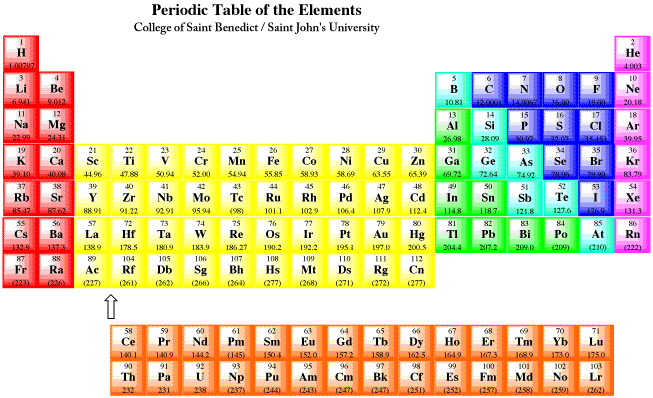
Figure AT6.1. The periodic table. Cherry-red elements are the alkali and alkaline world metals (s-block). Yellow elements are the transition metals (d-block). Orange elements are the lanthanides and actinides (f-block). Greenish, blue and purple elements are the p-block; together with the s-cake, they are chosen the main group elements. The main group is divided into metals (green), metalloids (teal), non-metals (blue) and noble or inert gases (majestic).
The outset two and the final vi columns of the periodic table are called the main group elements. Alternatively, they are sometimes called the s-cake and p-block elements, respectively. For example, phosphorus has a configuration, [Ne]4s24p10 1py 1pz one, or merely [Ne]4s24p3.
The heart block of the periodic table consists of the transition metals or the d-block elements. For example, scandium has configuration [Ne]4s23d1.
The last ii rows of the periodic table are the lanthanides and actinides. Collectively, they are called the f-cake elements. Samarium, for example, is [Xe]6s24f6. These elements could really be inserted at the left-mitt side of the d-block in the appropriate rows. Notice that lanthanum, element 57, is followed past hafnium, element 72, in the table. The element that really occurs adjacent is element 58, cerium, and it is shown in the lanthanide row downwardly below. The f-block elements are usually shown below in order to save infinite.
Really, the periodic table should look like this:
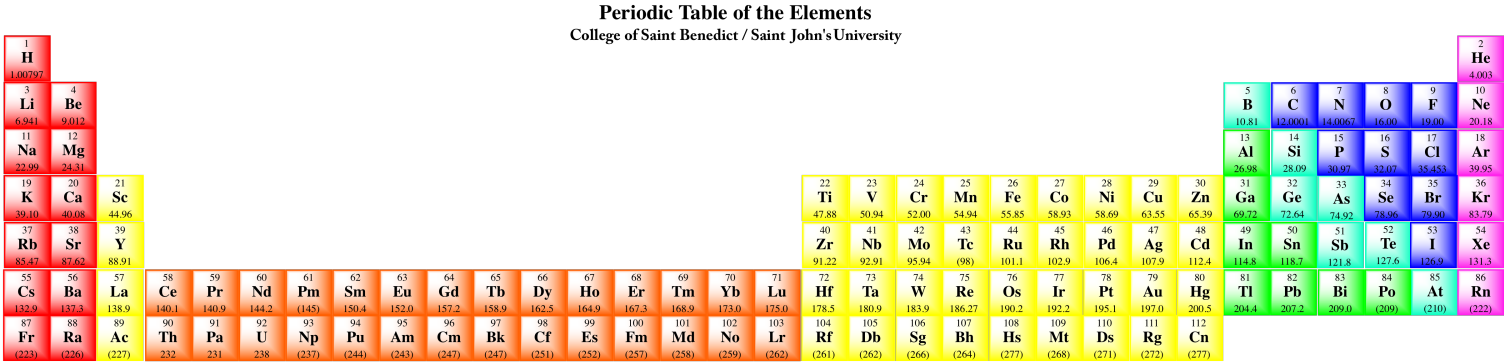
Figure AT6.2. The periodic table shown with the lanthanides in their proper places.
- The periodic tabular array is divided into columns of atoms with similar electron configurations.
- Atoms with similar electron configurations have similar properties.
Chemical reactions depend on the movement of electrons. In a reaction, 1 atom may take electrons from another atom. I atom may donate electrons to another atoms. The valence electrons are the outermost electrons in an atom; they are closest to the surface of an atom. That fact makes the valence electrons more likely to interact with other atoms. The valence are also the highest-energy electrons in an cantlet, and well-nigh likely to participate in a reaction.
For these reasons, atoms with similar electron configurations generally behave in similar ways. The repeating properties in each row of the periodic table, every bit observed by Mendeleev and others, reflect the repeating electron configurations in subsequent rows. The periodic table organizes atoms with similar configurations and properties together in columns.
Problem AT6.1.
For the following elements, propose two other elements that would have similar backdrop.
a) zinc, Zn b) calcium, Ca c) oxygen, O d) chlorine, Cl e) chromium, Cr
Trouble AT6.2.
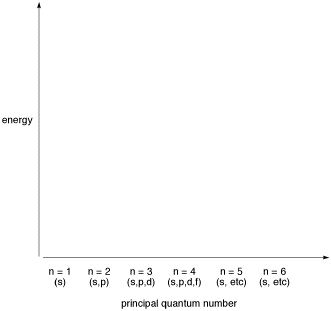
Make a diagram showing the energy levels of different orbitals, bundled by main breakthrough number.
"Periodic trends" refer to the way in which concrete backdrop of atoms change across the periodic tabular array. One of the most commonly used periodic trends in chemical science is electronegativity. Electronegativity is closely continued to the basic idea of chemical reactions: the transfer of an electron from one neutral cantlet to another. It refers to how strongly an atom attracts electrons from other atoms.
- Electronegativity is a measure out of an atom'due south ability to describe electrons towards itself, or the ability of the nucleus to concur electrons tightly.
At that place are many scales of electronegativity, based on different physical measurements. Usually, electronegativity is set to an approximately four-point scale. Atoms with electronegativity of around four draw electrons very strongly toward themselves. Atoms with electronegativity of 1 (or lower) only weakly draw electrons toward themselves.
The post-obit data use the Allen scale of electronegativity. The Allen scale uses spectroscopic measurements to estimate the free energy of valence electrons in an cantlet. From these values, the relative allure of the cantlet for its valence electrons is placed on a iv point scale (approximately).
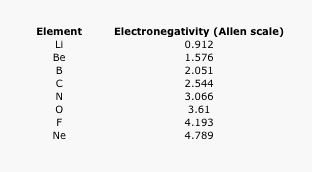
Table AT6.1. The Allen electronegativity values of the second-row elements.
Some electronegativity scales practice not have values for the noble gases, because they are based on experimental measurements of compounds, and noble gases do non commonly grade compounds with other elements. Instead, they exist every bit single atoms. The Allen scale only depends on the power of an atom to interact with light, which is something fifty-fifty noble gases can exercise. Equally a result, noble gases are also given electronegativity values on this calibration. However, on many scales, fluorine would be the most electronegative atom hither. As a result, fluorine is usually thought of as the most electronegative element.
Ofttimes it is useful to plot data on a graph. That way, we can go a better look at the relationship. For example, a quick glance at Figure AT5.two. shows that there is a smooth increase in electronegativity as we move beyond a row in the periodic table.
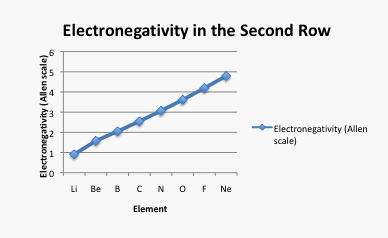
Effigy AT6.3. A plot of electronegativity versus diminutive number in the second row of the periodic table.
Problem AT6.three.
Have a look at the graph in figure AT6.ii. Tin y'all explicate why the electronegativity increases as atomic number increases?.
Problem AT6.4.
Suppose you need an electron. You take a boron cantlet and an oxygen atom. You try to accept an electron abroad from one. Use Figure AT6.2. to predict which atom volition give up the electron more easily.
Problem AT6.5.
Suppose you take an electron. You are able to ship it into a vessel that contains a carbon atom and a fluorine cantlet. Utilize Figure AT6.ii. to predict which atom is more likely to take the electron.
Problem AT6.6.
A covalent chemical bail is a pair of electrons shared betwixt ii atoms. Suppose you take a carbon-oxygen bond. Volition the electrons be shared evenly between the 2 atoms, or will one atom pull the electrons more than tightly towards itself? Utilise Figure AT6.2. to make your prediction.
What is happening every bit we move across a row in the periodic table? Why does electronegativity increase?
Keep in mind that the but departure from one chemical element to the side by side is the number of protons in the nucleus. The number of protons is called the atomic number. If you know the number of protons you have, and then you know what atoms y'all have. Electronegativity may have something to exercise with the number of protons in the nucleus. In fact, it should. The more protons there are in the nucleus, the more strongly electrons should be attracted to information technology. Each additional proton should add more than electrostatic attraction for an electron. Fluorine, with nine protons, should attract electrons much more strongly than lithium, which has only 3 protons.
- Moving across a row of the periodic table, as protons are added to the nucleus, electrons are held more tightly.
- Electronegativity increases across a row in the periodic table.
It seems like that effect should be offset past the increasing number of electrons in the atom. Each fourth dimension a proton is added, then is an electron. That electron should repel other electrons in the cantlet, cancelling out the outcome of more protons in the nucleus.
Yet, the construction of the cantlet minimizes electron-electron repulsion a footling bit. Call back that all the protons are in one place, the nucleus. All the electrons are a relatively great altitude from the nucleus, in many different directions. Chances are, an additional electron is much farther abroad; it may be twice as far away as an boosted proton in the nucleus. Information technology may be all the fashion on the other side of the atom. Because electrons are spread out in the cantlet, and the distances between them is pretty large, the repulsive issue is a little smaller than the attractive result of additional protons.
Nosotros tin can see that this trend is more often than not true across the periodic table, with a few exceptions here and there.
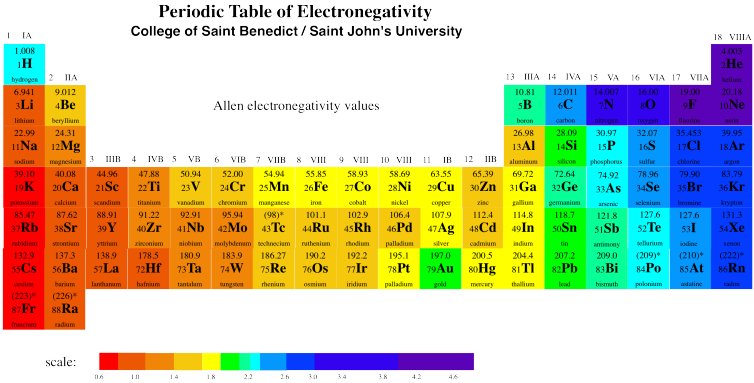
Figure AT6.4. Electronegativity trends beyond the periodic table. Download a copy.
What happens equally nosotros move down a column in the periodic tabular array? Table AT5.2. shows the Allen electronegativities of the alkali metals. These elements are also called the Grouping 1 elements or the Group IA elements. The "Group one" designation is used because they are the first column or group in the periodic table. The information are also presented in Figure AT5.4.
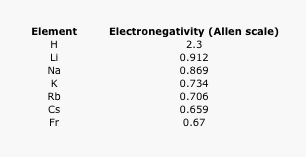
Tabular array AT6.two. The Allen electronegativity values of the alkali elements.
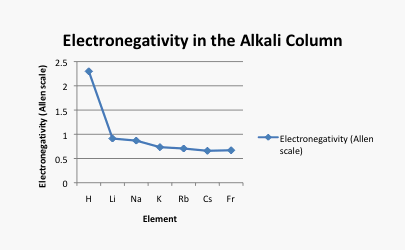
Figure AT6.5. Plot of the Allen electronegativity values of the alkali elements.
At that place is a different trend here. In this case, lithium (diminutive number three) has more protons than hydrogen (atomic number ane). However, hydrogen is a lot more than electronegative than lithium. Francium, with 87 protons in its nucleus, is the to the lowest degree electronegative alkali element.
Trouble AT6.7.
Take a look at the graph in effigy AT6.4. Tin you lot explain why the electronegativity decreases equally diminutive number increases, going downwards this column?
Problem AT6.8.
An ionic chemical bond is a pair of ions attracted by their opposite charges. A cation is a positively charged ion; it may exist an cantlet that has lost an electron. An anion is a negatively charged ion; it may be an atom that has gained an extra electron. Ions tin form by moving an electron from one atom to another.
a) Suppose you lot accept an ionic cesium-fluorine bail. Which ion is the cesium and which is the fluorine? Utilise Figure AT6.ii and Figure AT6.4. to make your prediction. Cesium is Cs.
b) Suppose you accept an ionic sodium-oxygen bail. Which ion is the sodium and which is the oxygen? Use Effigy AT6.2 and Effigy AT6.four. to brand your prediction. Sodium is Na (from the Latin, natrium).
c) Suppose you lot have an ionic potassium-hydrogen bond. Which ion is the potassium and which is the hydrogen? Use Figure AT6.2 and Effigy AT6.iv. to brand your prediction. Potassium is Grand (from the Latin, kalium).
Periodic Trends and Diminutive Radius
The biggest difference betwixt ii atoms in the same grouping (column) in the periodic tabular array is the principal quantum number. Remember, that corresponds to the "valence shell". Call back of electrons every bit forming layers around the nucleus. Electrons with principal breakthrough number one form a first layer. Those with primary quantum number 2 form a second layer, and and then on. Each layer is further away from the nucleus. Remember, electrostatic attraction gets weaker every bit charges get further away from each other. As electrons get farther from the nucleus, they are less tightly held.
- Moving downwards a column in the periodic table, valence electrons are held less tightly considering they get further from the nucleus.
- Electronegativity decreases as we move downwards a column in the periodic table.
We can see this full general size tendency in the following periodic table. This table presents covalent radii, which are related to the sizes of the atoms (although non exactly the same; information on atomic radii are non available for all atoms, however).
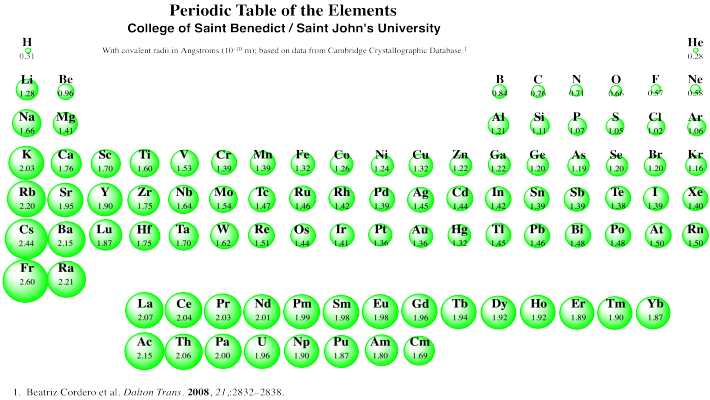
Effigy AT6.6. Covalent radii of the atoms. Download a copy hither.
We can clearly see the expanding radii of atoms if we look at Group one, the beginning cavalcade; these elements are called the alkali metals. Hydrogen, at the top, is very modest. Lithium is much bigger. Sodium is much bigger than lithium, all the same, and potassium is much bigger than sodium. And so on: francium is bigger than cesium, which is bigger than rubidium, which is bigger than potassium.
Each time an electron is added to an orbital that is significantly further from the nucleus, of grade it is going to result in a bigger cantlet. Remember, the atom is mostly empty space, and its size is described by the outermost reaches of its electrons. So when we go to the next principal quantum number -- that is, to the adjacent row in the periodic table, from the kickoff row to the second row, for case -- the next electron is much further away from the nucleus. It has to exist that mode, considering electrons repel each other. They can't all be as close to the nucleus, because there would be too much repulsion. Instead, they form these layers, and when the first layer is so full that at that place would be likewise much repulsion if anothe relectron were added, we get-go the next layer.
Of grade, the very first layer is very, very small. There just isn't that much room so close to the nucleus. For the first row, only ii electrons are allowed. Then they have to start the side by side layer. For the second row, eight electrons are allowed; that's the origin of something called the "octet rule" (think "octopus") for common compounds, which you'll see later on. Eventually nosotros become to eighteen electrons in a beat, then thirty two, equally the shells get bigger and bigger like layers of an onion, or like nested Russian dolls.
There is another important tendency if you expect carefully. As yous move from left to correct across the periodic table, from ane group to the next, the atoms get bigger. That doesn't brand any sense, does information technology? If nosotros are adding more electrons, why would the atom get smaller?
The key matter is, not just are nosotros calculation more electrons, but nosotros are also adding more protons in the nucleus. The new electrons we are calculation are all roughly equidistant from the nucleus; they are all equally close to the protons. And then as the charge on the nucleus gets bigger, those electrons are all more strongly attracted to the centre. The atom shrinks.
Eventually, nosotros get to the point at which we couldn't possibly add together more electrons; the radius has shrunk so much that repulsion would get besides bang-up if we added i more electron. And so we merely start another row. Just before that bespeak, however, we hit a sweet spot: the bespeak at which the attraction between the nucleus and the outermost electrons is so strong, and the electrons are held and so tightly, that the atom becomes very, very stable. This final column in the table contains the noble gases, which are particularly stable and unreactive.
Trouble AT6.9.
Why does electronegativity fall so sharply between hydrogen and lithium, and much more subtly between lithium and sodium?
Trouble AT6.x.
Which atom, in the post-obit pairs, is more than electronegative?
a) magnesium, Mg, or calcium, Ca
b) atomic number 82, Pb, or can, Sn
c) argent, Ag, or antimony, Sb
d) gallium, Ga, or arsenic, As
due east) tungsten, Westward, or copper, Cu
f) thallium, Tl, or sulfur, Southward
Problem AT6.eleven.
Electron ionization is the energy that must be added in order to pull an electron away from an atom.
a) Why do yous think free energy has to be used to pull an electron away from an atom? What is holding the electron there?
b) Explain the general trend in ionization energies seen in the following table (a larger value means more free energy must be added to remove a outset electron from the atom).
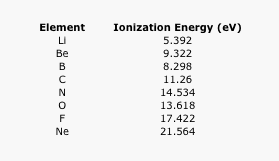
Tabular array AT6.six. The ionization energies of the 2d row elements.
Problem AT6.12.
Sometimes a plot of the data can be revealing. Ionization energies do not follow a smooth tendency. Explain why it is a little easier to remove an electron from boron and oxygen than expected. (Electron configurations may be helpful here.)
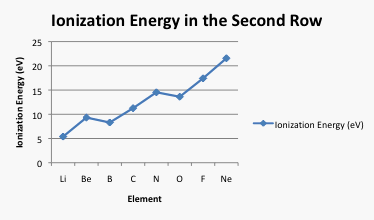
Figure AT6.vii. Plot of the ionization energies of the second row elements.
Trouble AT6.13.
Explain the trend in the following data on ionization energy.
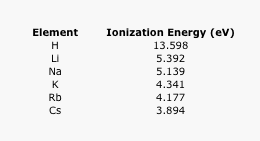
Table AT6.four. The ionization energies of the alkali elements.
Problem AT6.14.
Electron affinity is the free energy released when a gratis electron is picked up by an atom.
a) Why would free energy be released when a free electron is taken past an atom?
b) Explain the general trend in the following electron affinity data.
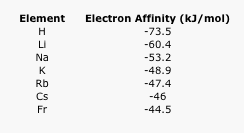
Table AT6.5. The electron affinities of the alkali elements.
Problem AT6.xv.
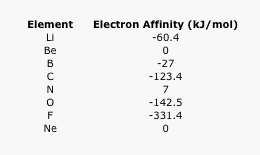
a) Explicate a general tendency in the post-obit electron affinity data.
b) At that place are several exceptions to the general trend. Why do beryllium and neon have such depression electron affinities (almost naught)?
c) Nitrogen as well has an electron affinity that is shut to zero. Why?
Problem AT6.16.
Ordinarily, elements get bigger as we become down a column in the periodic table. Yet, in a phenomenon called "the lanthanide contraction", some elements are really smaller than the ones in the row to a higher place them. Specifically, osmium, iridium, platinum, gilded, and mercury are smaller than their relatives, ruthenium, rhodium, palladium, argent, and cadmium, respectively.
Use the periodic tabular array in Figure AT6.ii. to offer a possible explanation for this phenomenon.
This site is written and maintained by Chris P. Schaller, Ph.D., College of Saint Benedict / Saint John's University (with contributions from other authors as noted). Information technology is freely available for educational utilize.

Structure & Reactivity in Organic, Biological and Inorganic Chemistry by Chris Schaller is licensed under a Artistic Commons Attribution-NonCommercial three.0 Unported License.
Send corrections to cschaller@csbsju.edu
Navigation:
Back to Atoms
Back to Construction
Back to Structure & Reactivity

What Determines An Atom's Reactivity,
Source: https://employees.csbsju.edu/cschaller/Principles%20Chem/atoms/atomperiodic.htm
Posted by: jonesrousameltood.blogspot.com
0 Response to "What Determines An Atom's Reactivity"
Post a Comment