

How Did Early Humans Get To Australia
By the time our planet was 4 billion years quondam, the ascent of large plants and animals was simply starting time. Complexity exploded around that time, as the combination of multicellularity, sexual reproduction, and other genetic advances brought well-nigh the Cambrian explosion. Many evolutionary changes occurred over the next 500 million years, with extinction events and selection pressures paving the mode for new forms of life to ascend and develop.
65 million years ago, a catastrophic asteroid strike wiped out not simply the dinosaurs, merely practically every animal weighing over 25 kg (excepting leatherback sea turtles and some crocodiles). This was Earth's nearly recent great mass extinction, and information technology left a big number of niches unfilled in its wake. Mammals rose to prominence in the backwash, with the kickoff humans arising less than i 1000000 years ago. Here's our story.
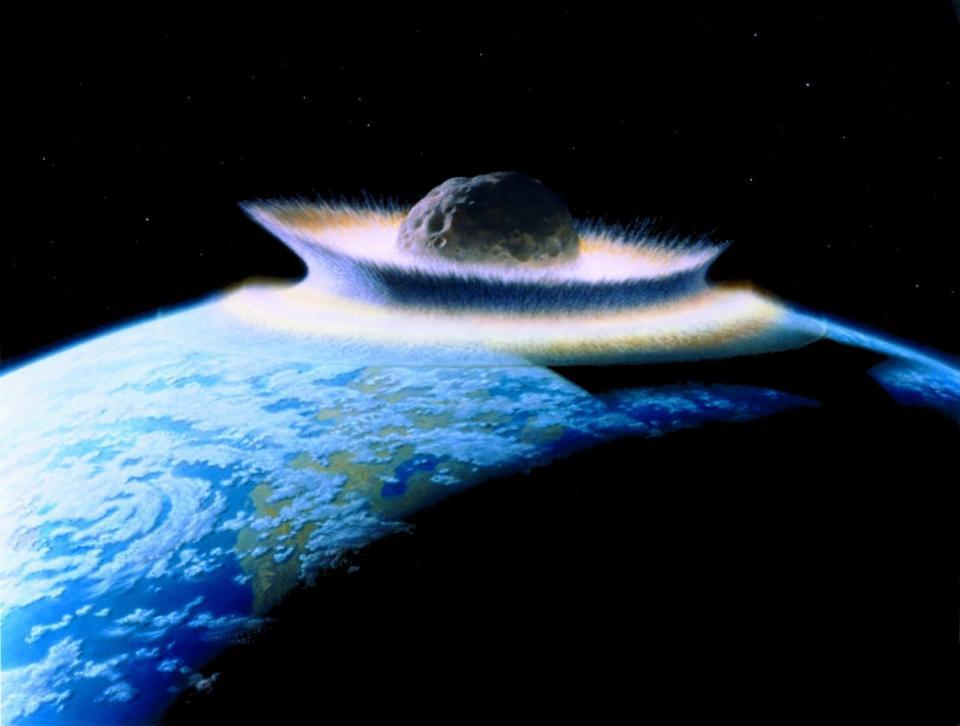
A planetoid colliding with Earth, coordinating to (simply larger and slower-moving) a potential bear upon between Swift-Tuttle and Earth. The asteroid that wiped out the dinosaurs had just 1/26th the energy that being hit by Comet Swift-Tuttle would behave, and that impact was enough to wipe out 75% of all species on World. (Credit: NASA/Don Davis)
65 million years ago, a massive asteroid somewhere between five and x kilometers in diameter struck our planet. It kicked upward a layer of dust that settled all over the earth, a layer that tin be found today in our planet's sedimentary stone. On the older side of that layer, fossils such every bit dinosaurs, pterosaurs, ichthyosaurs and plesiosaurs are abundant. Giant reptiles, ammonites, and large classes of plants and animals all existed prior to that event, along with minor, flying birds and the tiny, country-domicile mammals.
After that upshot, the mammals survived. With no larger predators to stop them, they grew, diversified, and experienced a population explosion. Primates, rodents, lagomorphs, and other forms of mammals, including placental mammals, marsupials, and even the egg-laying mammals are all abundant at the start of the Cenezoic epoch.
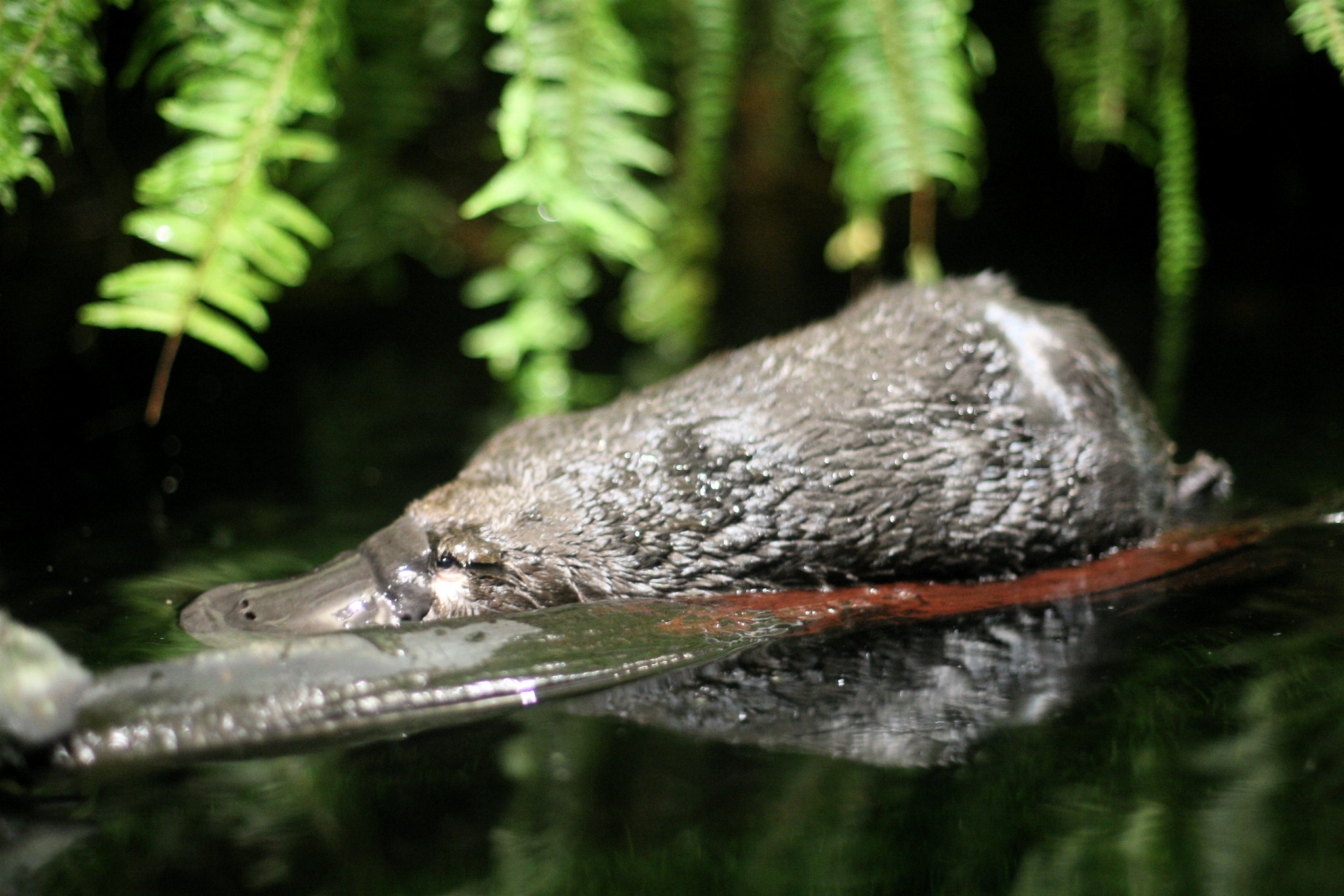
A duck-billed platypus (Ornithorhynchus anatinus) swims in the enclosure at the Melbourne Zoo in Commonwealth of australia. Despite the fact that it lays eggs, has a bill, and has a myriad of features we don't typically associate with mammals, the duck-billed platypus is more than closely related to us than information technology is to whatever extant bird or reptile. (Credit: Small-scale/flickr)
Almost immediately, the primates began diversifying even farther. 63 million years ago — simply 2 million years after the demise of the dinosaurs — they divide into ii groups.
- The dry-nosed primates, known formally as the haplorrhines, which developed into modernistic monkeys and apes.
- The wet-nosed primates, known as the strepsirrhines, which developed into modernistic lemurs and yeah-ayes.

Travel the Universe with astrophysicist Ethan Siegel. Subscribers will get the newsletter every Saturday. All aboard!
58 million years ago, some other big change occurred: the haplorrhines experienced an interesting genetic separate, equally the first novel and unique evolutionary co-operative became distinct from the rest of the dry-nosed primates: the tarsier. With its enormous optics, it was uniquely well-adapted to see at dark.
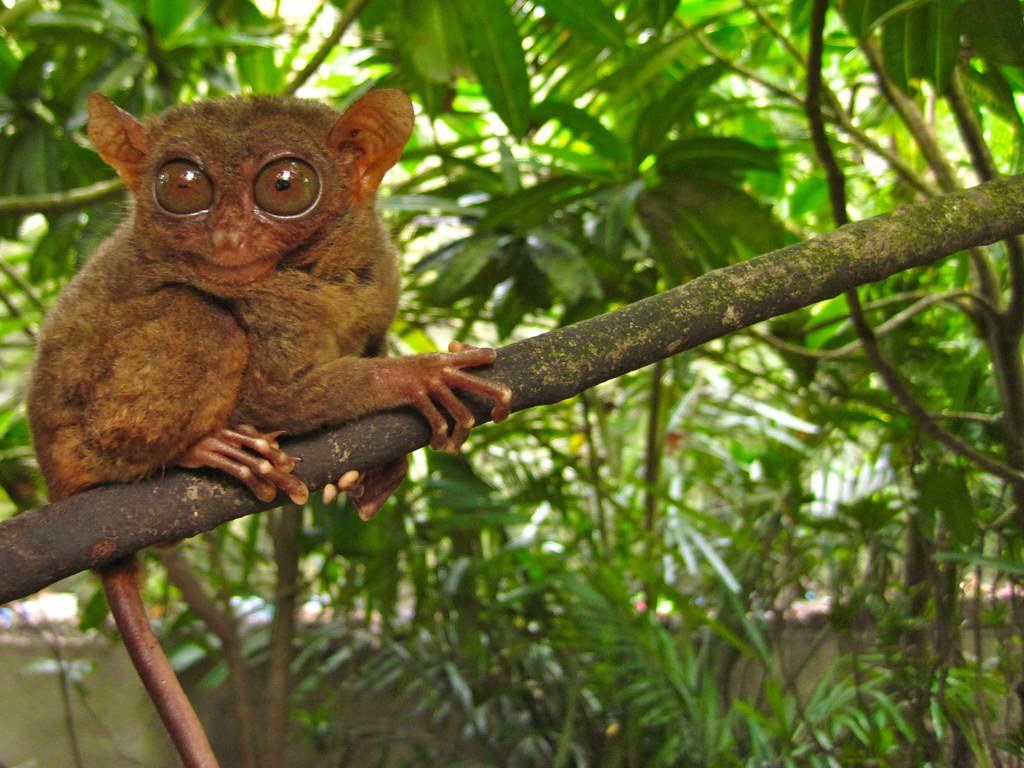
With its enormous eyes but a dry nose, the tarsier holds the distinction every bit the kickoff haplorrhine to diverge from the mammalian lineage that would give rise to monkeys, apes, and eventually mod humans. Note that they take dry, rather than moisture, noses. (Credit: Via Tsuji/flickr)
The niche it at present occupied was sufficiently different from the remaining groups of our ancestors that they evolved differently from the residual of their cousins from this signal onwards. This type of evolutionary splitting occurs every so frequently, and isn't unique to primates.
Although nosotros unremarkably don't think very much about our distant cousins and how they develop once they've split up off from united states, it isn't merely haplorrhines like u.s.a. (and our directly ancestors) that underwent interesting phases of evolution. All throughout the past 65 one thousand thousand years — but every bit it was before that time — the various mammals, birds, plants, and other living organisms evolved together. Evolution is driven by environmental changes, and that includes all the floral and faunal changes that occur on our planet.
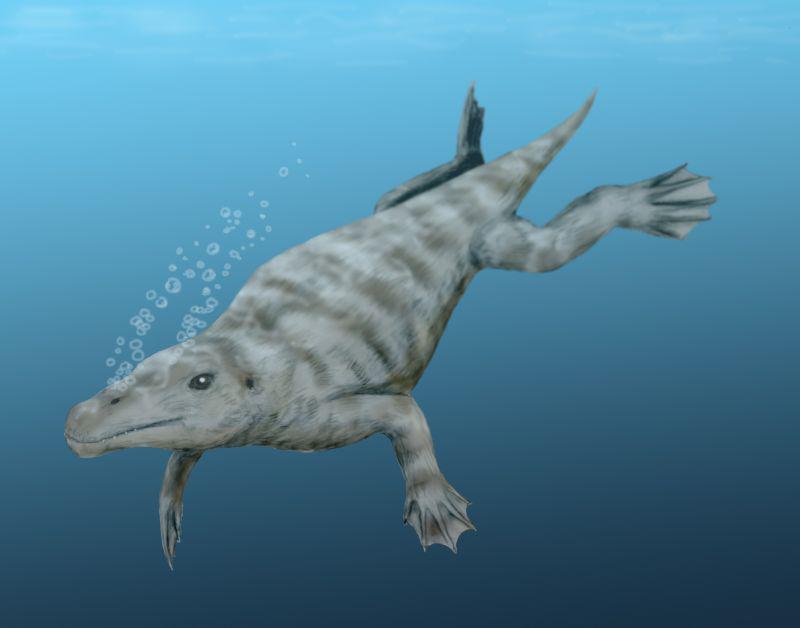
A reconstructed analogy of the protocetid Georgiacetus vogtlensis, a archaic whale-similar creature dating from the Eocene flow. (Credit: Nobu Tamura/ CC-by-SA-3.0)
55 million years agone, a sudden ascension in greenhouse gases acquired the global average temperature to swiftly rise, wiping out many deep-body of water animals and plants. This transformation left many large, unfilled niches in the body of water, paving the way for cetaceans (the large oceanic mammals) to develop.
fifty meg years ago, some of the even-toed mammals began evolving into ocean-dwelling creatures. The artiodactyls may have all evolved from a single, common ancestor, or may take evolved independently. Animals like Indohyus, which dates to 48 million years ago, may have given rising to protocetids: shallow-water mammals that returned to land to give birth.
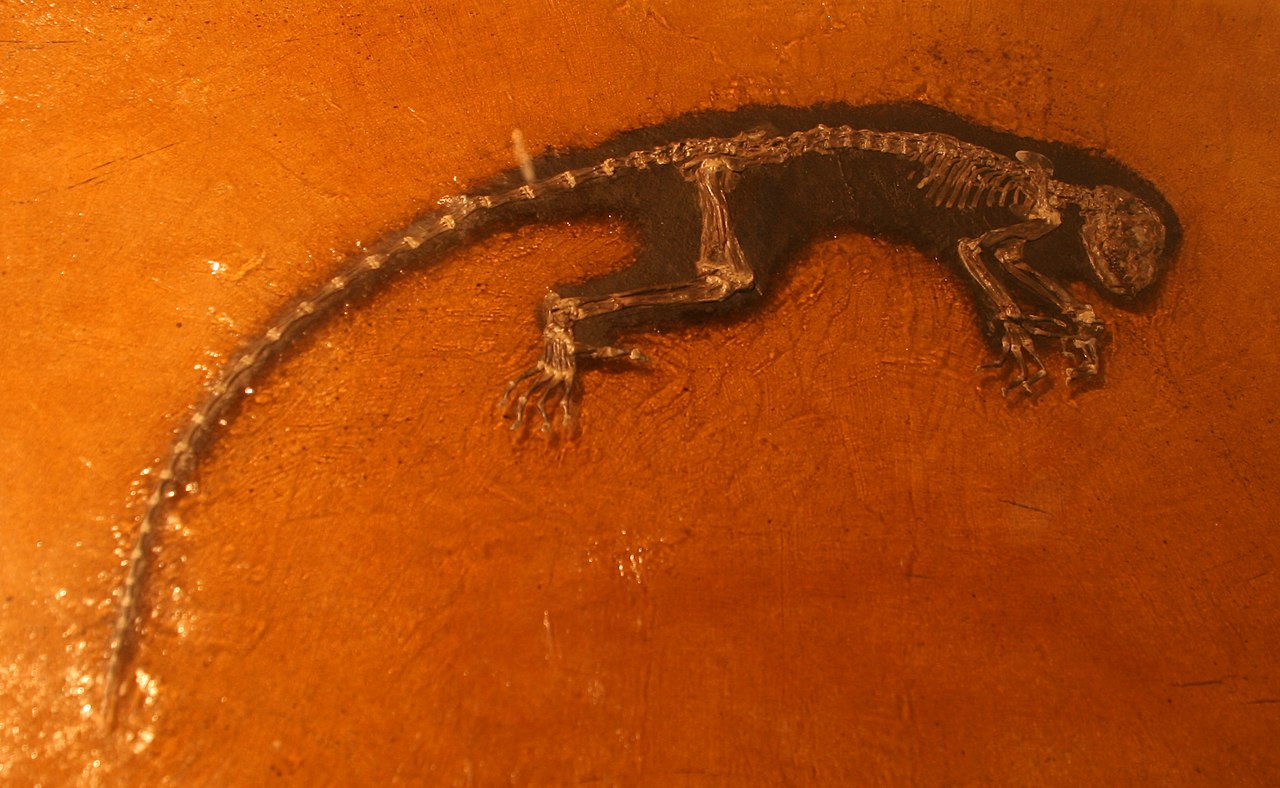
The early fossilized remains of Darwinius Masilae, known every bit "Ida," was originally thought by many to be a missing link in human ancestry, just this specimen is almost certainly a strepsirrhene, not a haplorrhine like monkeys, apes, and humans are. Although information technology dates back to 47 million years ago, it is probably more closely related to a lemur than it is to a human. (Credit: Nachosan/Wikimedia Commons)
Right around that fourth dimension, 47 million years ago, the primate Darwinius masillae existed, as the fossil Ida, preserved from that fourth dimension, provides a spectacular example. Although this was originally touted as a proverbial "missing link" in homo evolution, Ida is non a haplorrhine like us, simply a strepsirrhene: a wet-nosed primate.
But another 7 million years later — 40 meg years agone — an important development occurred amid the dry out-nosed primates: the New World monkeys branched off. Humans and our ape ancestors are descended from Old Globe monkeys; New World monkeys are the kickoff simians (or higher primates) to evolutionary diverge from our lineage. They would go on to colonize most of Southward America, where they are nonetheless found in abundance today.
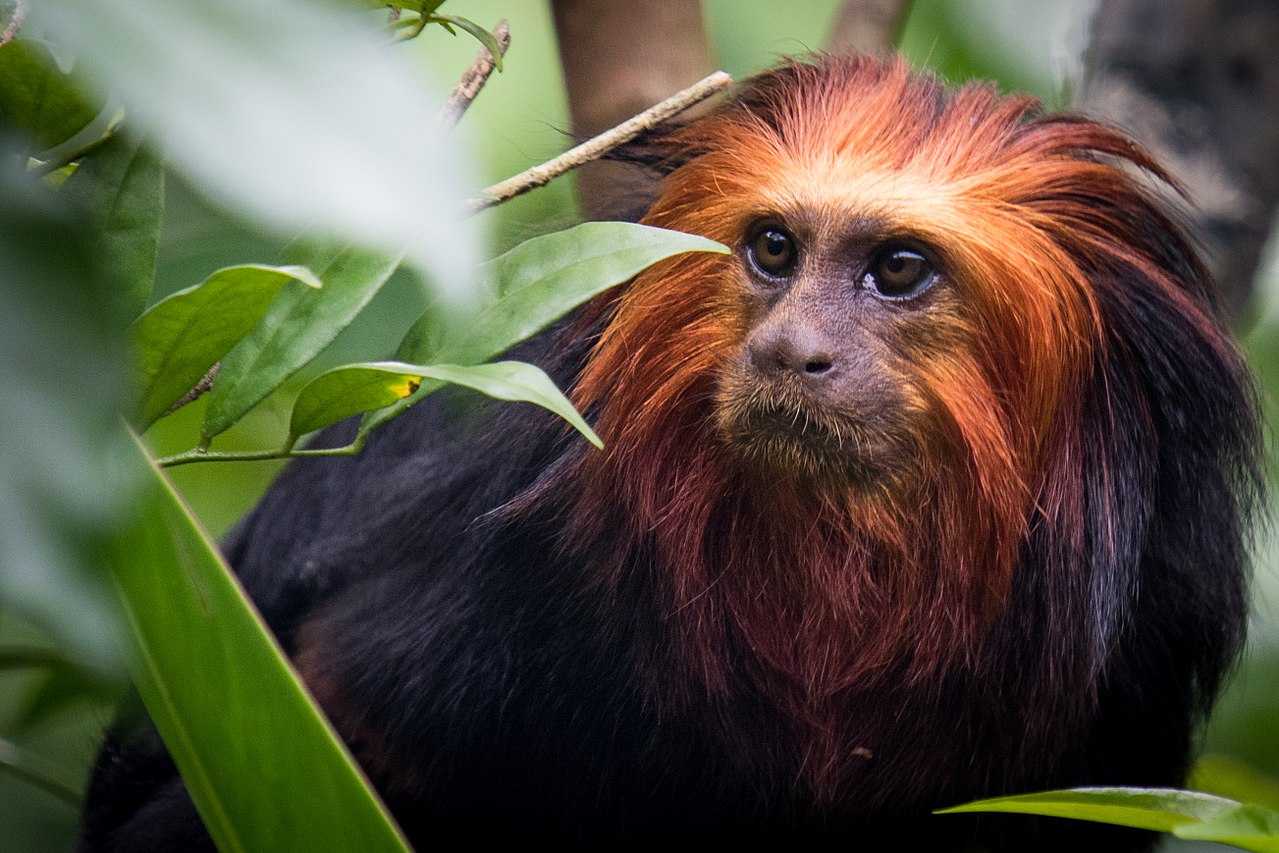
The gold-headed panthera leo tamarin is an example of a New World monkey. This endangered species of animal is part of a lineage that split off from the Old Earth monkeys that humans are a office of some 40 million years agone. (Credit: _paVan_/Wikimedia Commons)
The Old Globe monkeys keep to thrive and successfully occupy their niches, while diversifying in trunk size and physical features. 25 meg years agone, the first apes evolved, splitting off from the remaining Old World monkeys at that fourth dimension. The apes — defined by the complete lack of a tail of any blazon — would proceed to give rise to many of the close relatives of humans that survive today: both the bottom apes and the smashing apes.
The earliest ape to dissever off from the Old World monkeys was the Gibbon, a lesser ape that first emerged 18 meg years ago.
Sometime between fourteen and 16 million years ago, the commencement neat apes appeared, with Orang-utans branching off fourteen million years ago. The Orang-utans spread into southern asia after this, while the other great apes remained in Africa. The largest primate always, Gigantopithecus, first arose some 9 one thousand thousand years ago, but becoming extinct a few hundred thousand years ago.
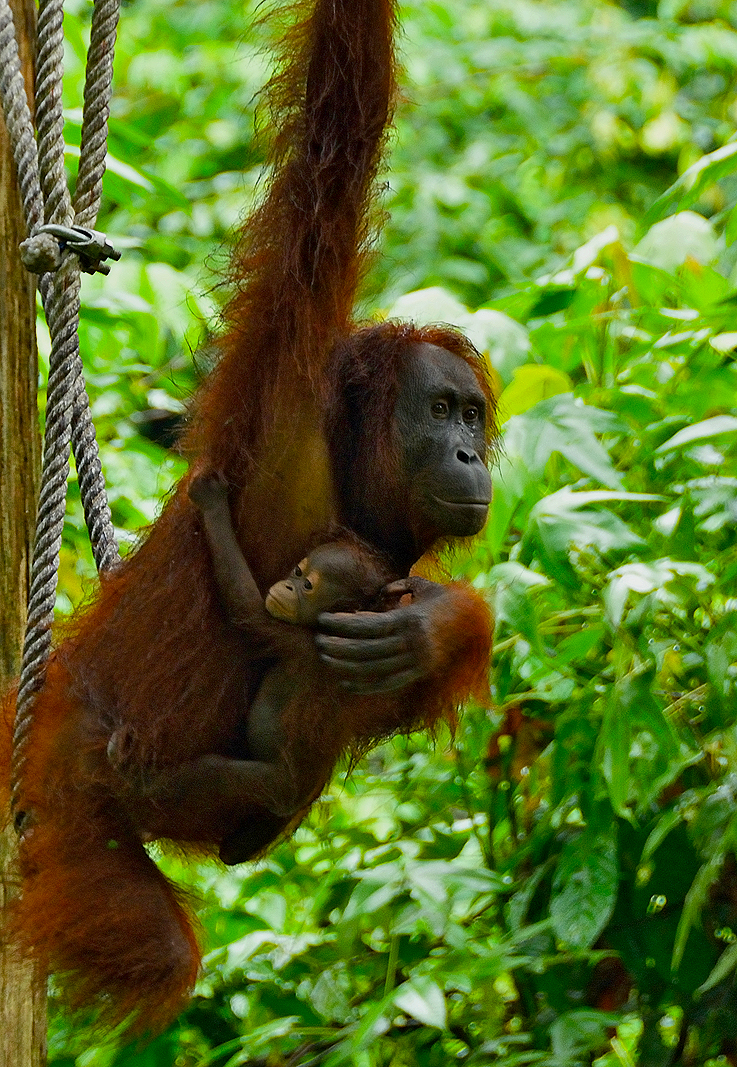
The Orang-utans are some of the earliest dandy apes to split off from our hominid ancestors, which they did some sixteen million years agone. Although they are true great apes similar we are, having no tails, they are less closely related to us than gorillas, bonobos, chimpanzees, or any of the later on-emerging members of the family hominidae. (Credit: ReubenST/Wikimedia Commons)
7 million years agone, gorillas branched off from the other great apes; they remain the largest of all the surviving primates.
The neat apes separate off in two directions vi meg years ago, with one direction giving ascension to humanity's ancestors and the other branch giving rise to chimpanzees and bonobos. The chimpanzee/bonobo co-operative remains unified for another four million years, with our closest surviving relatives — the chimpanzees and bonobos — diverging from one some other a mere 2 one thousand thousand years ago.
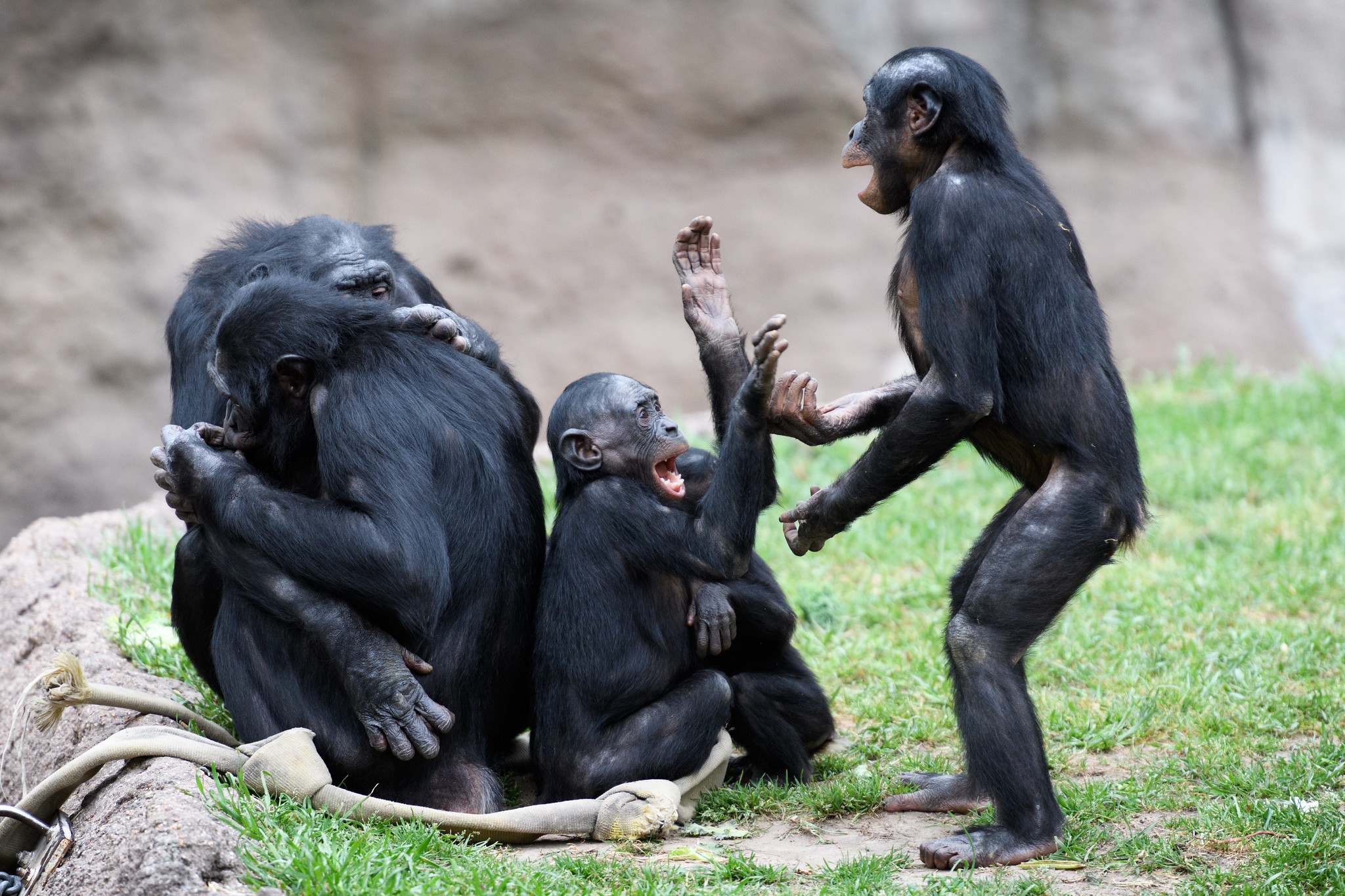
Bonobos, along with chimpanzees, are the two species well-nigh closely related to human beings that remain on Earth today. Bonobos are incredibly social, but all the same are not truly bipedal, as they maneuver on four limbs frequently. An evolutionary split that occurred approximately 5.six million years ago marks the departure of these creatures from modern humans. (Credit: Eric Kilby/flickr)
But along the track of our straight ancestors, the developments were rapid and profound. 5.half-dozen million years agone, the first truly bipedal ape, Ardipithecus, arose. Although information technology'southward a controversial claim, the hand bones in Ardipithecus testify evidence of it being a transitional fossil between the earlier great apes and the afterwards Australopithecines.
Approximately 4 million years agone, the get-go Australopithecus evolved: the first members of the Hominina subtribe (a taxonomic nomenclature more specific than family simply less specific than genus). Shortly thereafter, the first evidence of rock tool utilize appears: before long at 3.4-to-3.7 million years ago.
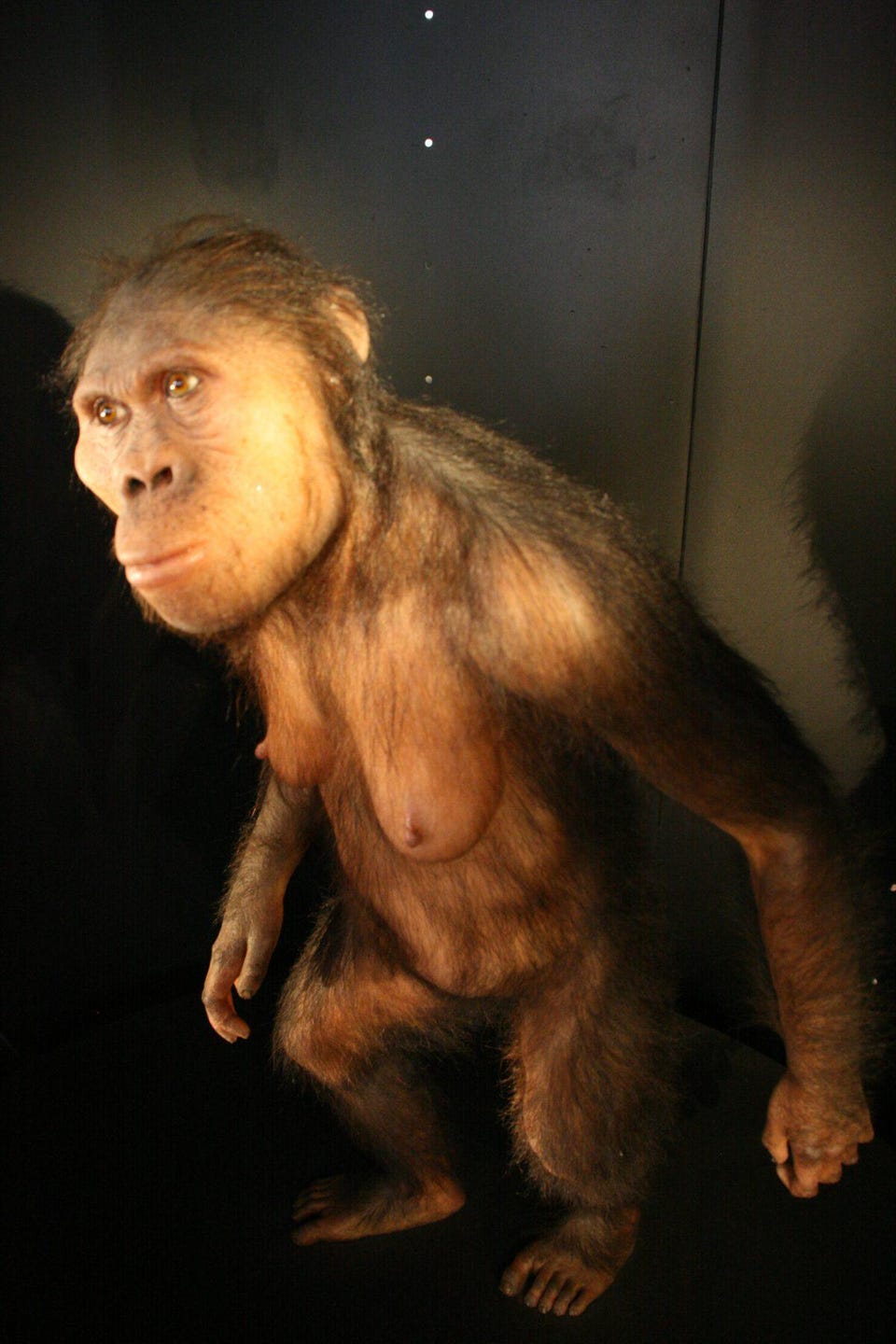
A reproduction of Australopithecus africanus, based on the STS5 skull ("Mrs. Ples") constitute in Sterkfontein, South Africa, dating to 2.vii 1000000 years agone. Australopithecus was the dominant hominid throughout Africa for nearly ii million years, until the rise of Homo habilis. (Credit: Nachosan/Wikimedia Commons)
A critical evolutionary step happened a little more than than ii million years ago, as our hominid ancestors faced food shortages. One evolutionarily successful approach was to develop stronger jaws, which gave us the capability to consume foods (like nuts) that were otherwise inaccessible. But another approach was as well successful: to develop weaker jaws and larger brains, enabling us to access the food.
While both groups survived for a time, the larger-brained grouping was more adaptable to changes, and they continued to survive. This is the evolutionary path that we call up led to the development of the genus Homo, which outset arose about two.v meg years ago. Homo habilis, known colloquially as "handy man," had larger brains than their Australopithecus counterparts and displayed far more widespread tool use.
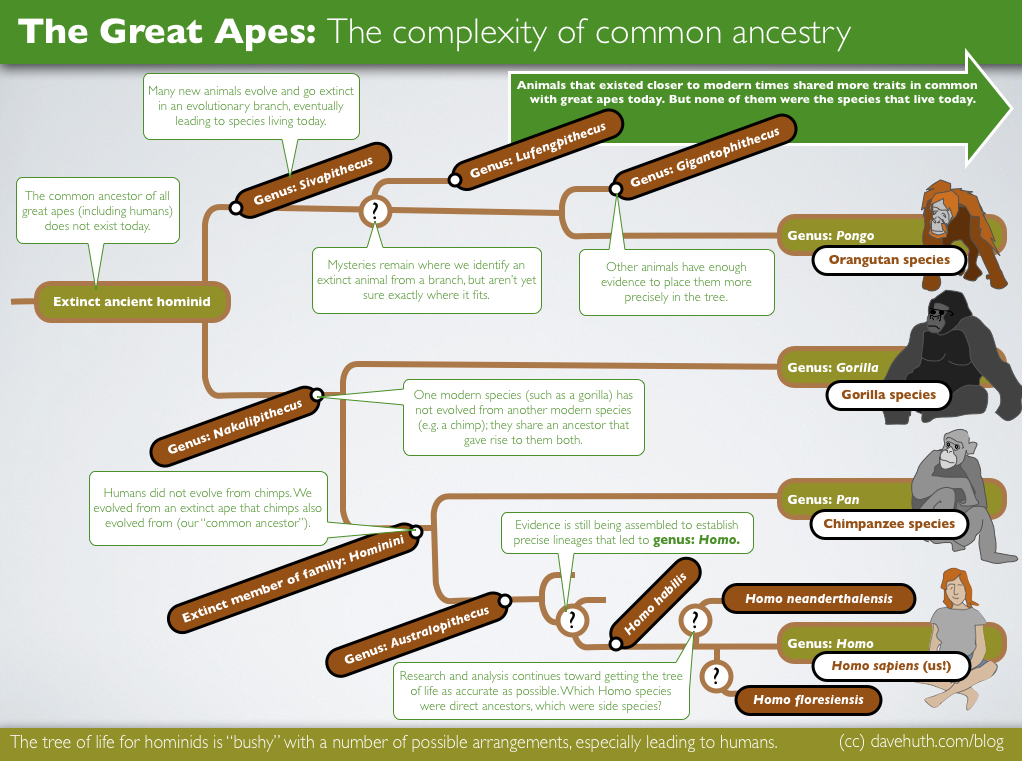
The evolutionary family tree of mod humans, some of our more afar cousins, and many of the intermediary species that existed at 1 time, but that have died out and/or evolved into other life forms by the present time. (Credit: Dave Huth/flickr)
About i.9 1000000 years ago, Human erectus evolved. This human ancestor not only walked fully upright, just had much larger brains than Man habilis: virtually twice as big, on average. Human erectus became the first direct homo ancestor to leave Africa, and the showtime to display testify of using fire. Homo habilis was likely driven to extinction more than than a million years ago, as was the last Australopithecus.
Across the earth, new examples of the genus Man emerged, including Homo antecessor in Europe (which may be an evolved habilis or erectus, or an early form of heidelbergensis) well-nigh i.2 meg years ago, followed past Human being heidelbergensis some 600,000 years agone. Approximately 700,000 years ago, the earliest prove for cooking appears; nearly 500,000 years agone, the kickoff evidence for habiliment appears.
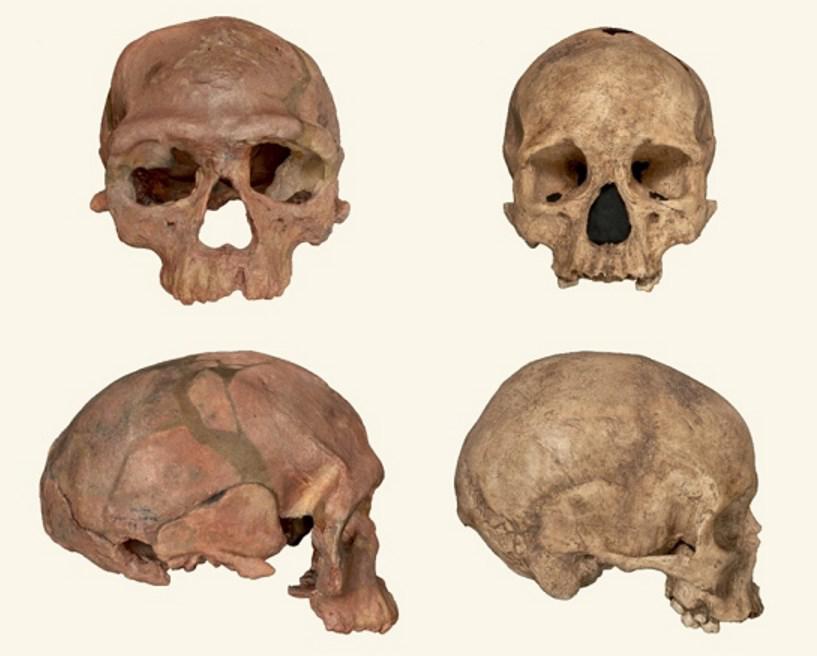
The oldest fossil remnants of Homo sapiens now appointment back to 300,000-315,000 years ago, and were constitute in Morocco. This detect, dating back to only 2017, pushes back our species' origin before than the development of the Neanderthals, and suggest that we didn't evolve only in Eastward Africa, as previously believed. (Credit: Natural History Museum London/Nature)
Approximately 300,000 years ago, the first Homo sapiens — anatomically mod humans — arose alongside our other hominid relatives. It is unknown whether we descended directly from Human erectus, heidelbergensis, or antecessor, although Neanderthals, which came slightly later at 240,000 years agone, nigh certainly came from Human heidelbergensis. Mod speech is thought to have arisen almost every bit soon as Homo sapiens did.
Information technology took 13.8 billion years of cosmic history for the beginning human beings to get in, and we did so relatively recently: but 300,000 years ago. 99.998% of the time that passed since the Large Bang had no human beings at all; our entire species has only existed for the most recent 0.002% of the Universe. Nevertheless, in that short fourth dimension, we've managed to figure out the entire cosmic story that led to our existence. Fortunately, the story won't cease with us, as it'southward nevertheless being written.
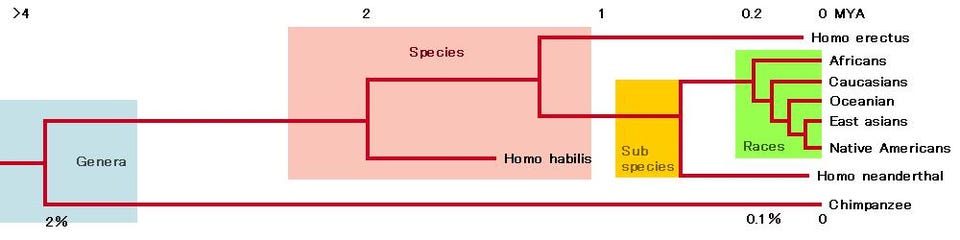
Evolutionarily speaking, human beings – or homo sapiens – take been effectually for a cosmic blink-of-an-eye: nether half a million years. Based on how evolution works, it is unlikely there will be whatever humans left even but a few meg years from now. (Credit: asdfgf/Wikimedia Commons)
Ethan is on holiday. Delight savour this older article from the Starts With A Bang archives!

How Did Early Humans Get To Australia,
Source: https://bigthink.com/starts-with-a-bang/first-humans-on-earth/
Posted by: jonesrousameltood.blogspot.com
0 Response to "How Did Early Humans Get To Australia"
Post a Comment